
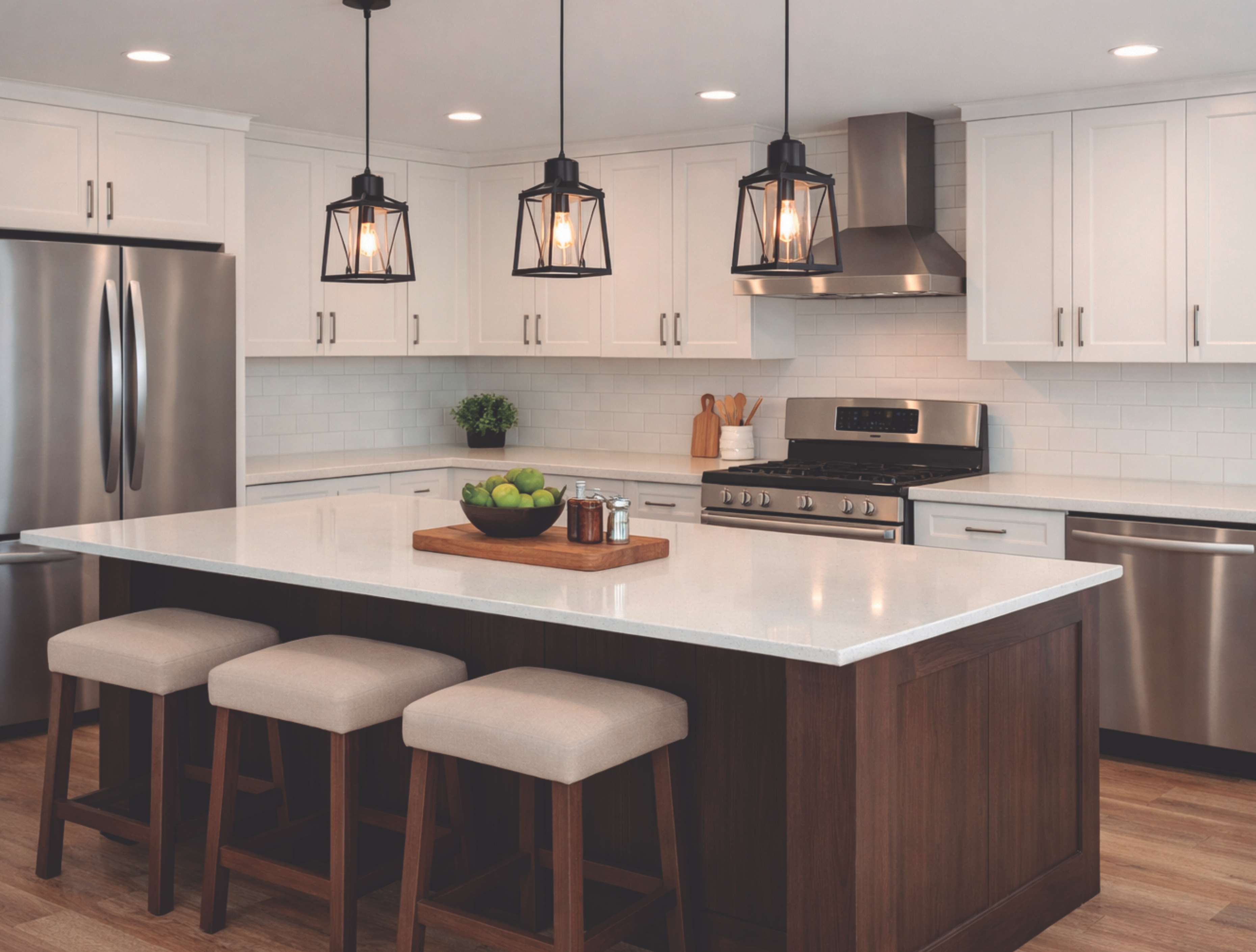
A kitchen countertop is not simply a workspaceâ€â€it is a major design anchor and one of the most critical factors impacting your home’s resale value. When planning a remodel or new construction project in Southern Saskatchewan, you will inevitably find yourself comparing the three heavyweights of premium stone: **quartz, granite, and quartzite**.
While all three options deliver exceptional luxury, they are chemically distinct and serve different functional lifestyles. In this guide, we break down what separates these materials, helping you make an informed choice for your cabinetry.
1. Granite Countertops: The Timeless Natural Option
Granite is a completely natural igneous rock composed mainly of quartz and feldspar, created through high temperatures and crystallization deep under the earth. Because it is formed under extreme thermal pressures, granite possesses exceptional heat resistance.
"Granite resists direct heat up to 1200°F. Placing hot pans straight from the stove onto your granite island will not burn or scorch the surface."
Our custom granite countertops are highly non-porous naturally, which means they do not absorb staining agents or moisture easily. This natural density means they do not require artificial sealants to provide protection against mold, mildew, and common kitchen stains.
2. Engineered Quartz: Zero Maintenance, Modern Appeal
Unlike granite, quartz countertops are engineered. Slabs are manufactured using roughly 93% loose quartz crystals bound together with 7% synthetic resins and coloring pigments. This manufacturing process allows for consistent pattern layouts, mimicking marble without marble’s fragile porosity.
The primary advantage of quartz is its zero-maintenance profile. Because it is entirely non-porous, it never requires sealing. However, the resin binders make quartz susceptible to thermal shock. Placing a hot pan directly onto quartz can cause permanent scorching or cracking, so using hot pads is mandatory.
3. Quartzite: The Crystalline Masterpiece
Quartzite is a natural metamorphic rock created when pure quartz sandstone undergoes extreme tectonic heating and pressure. The result is a rock that is even harder than granite, featuring an elegant, translucent crystalline structure that resembles premium marble.
Quartzite is highly scratch-resistant and heat-tolerant. However, because it is a natural quartzite sandstone derivative, it remains naturally porous. We apply a heavy-duty impregnating sealer during installation, and we recommend reapplying it every 1 to 2 years to keep the slab stain-proof.
Comparing Durability, Style, and Care
When selecting your slab, think about how you use your kitchen. For avid home chefs who cook frequently with hot cast iron, granite is usually the best match due to its high heat tolerance. For modern homeowners looking for a uniform, minimalist white marble look with zero maintenance, quartz is a superb choice. If you seek the ultimate one-of-a-kind visual statement with extreme durability, quartzite is the gold standard.
Make Your Decision at Our Showroom
Stone is a tactile material. Seeing photographs online is helpful, but inspecting the details of full slabs under correct showroom lighting is unmatched. We invite you to schedule a showroom visit at our fabrication facility in **Belle Plaine, SK** (conveniently located between Regina and Moose Jaw). Our design specialists can walk you through slab layouts, sample matches, and edge profiles.